

To save Instagram stories permanently, download the original MP4 or JPG file using a web-based story tool — not a screenshot or screen recording. The saved file lives in your normal phone gallery or downloads folder, never expires, and survives the original owner deleting their story. Back it up to a cloud service once and your archive is bullet-proof.
⚡ Key takeaways
- Original-file downloads keep full quality; screenshots and recordings always lose detail.
- Saved stories sit in your normal gallery or downloads folder — nothing exotic.
- One cloud backup turns “keepable” into “truly permanent”.
- Organise by date and theme so the archive is searchable a year later.
- Private or deleted stories cannot be saved — that limit is structural.
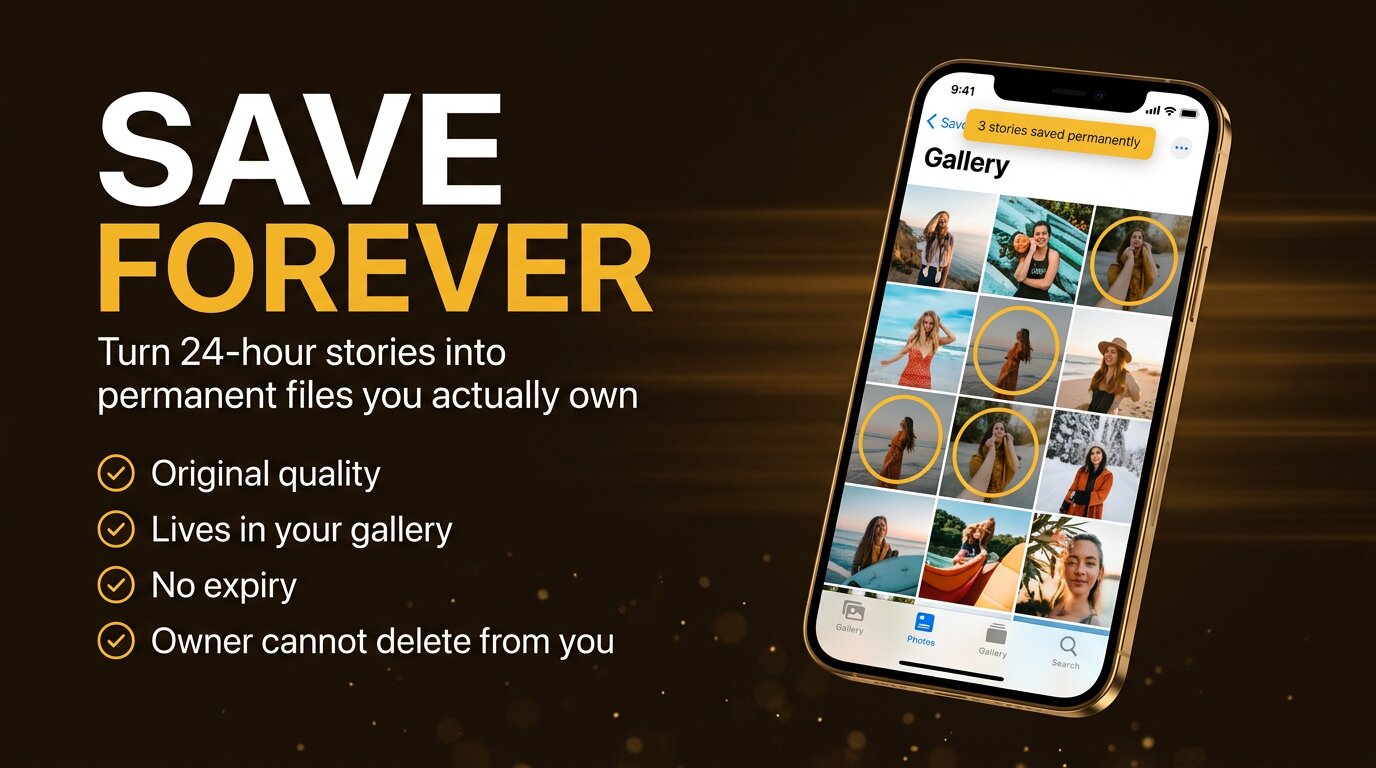
Instagram stories were built to disappear — 24 hours and gone, by design. That works for the platform; it doesn’t work for the moments inside the stories. A friend’s wedding teaser, your competitor’s launch announcement, a recipe demo you wanted to follow next week, your own creative output — none of those benefit from vanishing on a timer. This guide is about turning a 24-hour clip into a permanent file you actually own, organise, and can find years later.
What follows: why screenshots aren’t the answer, the right way to grab the original source, where the file actually lives once you save it, how to back it up properly, how to keep an archive that still makes sense after months, and the small set of situations where permanent saving simply isn’t possible.
Why screenshots and recordings aren’t enough
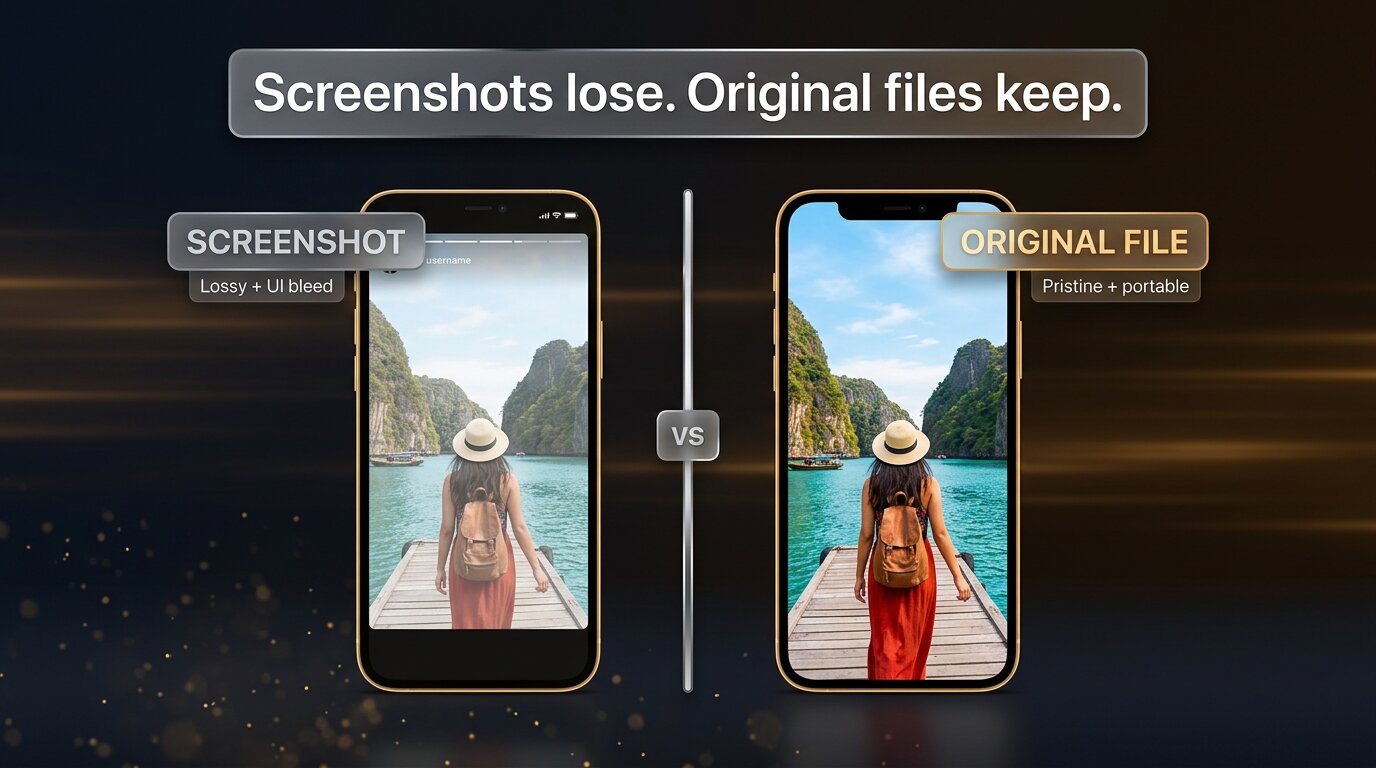
Screenshots and screen recordings feel like the obvious way to keep a story, but they produce inferior copies. Three things go wrong:
- Compression on compression. The story arrived already encoded by Instagram. Your phone re-encodes it again. Detail is thrown away twice.
- UI baked into the frame. Progress bars at the top, a username overlay, your phone’s status bar, sometimes a finger’s edge — all permanently in the saved file.
- Wrong format and aspect ratio. Screen recordings include the device chrome and bezels; the file is heavier and lower-quality than the original media inside it.
The right alternative is downloading the actual source file Instagram is currently serving — the same MP4 the app plays for you, untouched. Same colours, same resolution, same aspect ratio, no UI overlay. The difference is most visible when you re-open the file on a laptop or print it: a screenshot falls apart, the original holds up.
The right way: download the source file
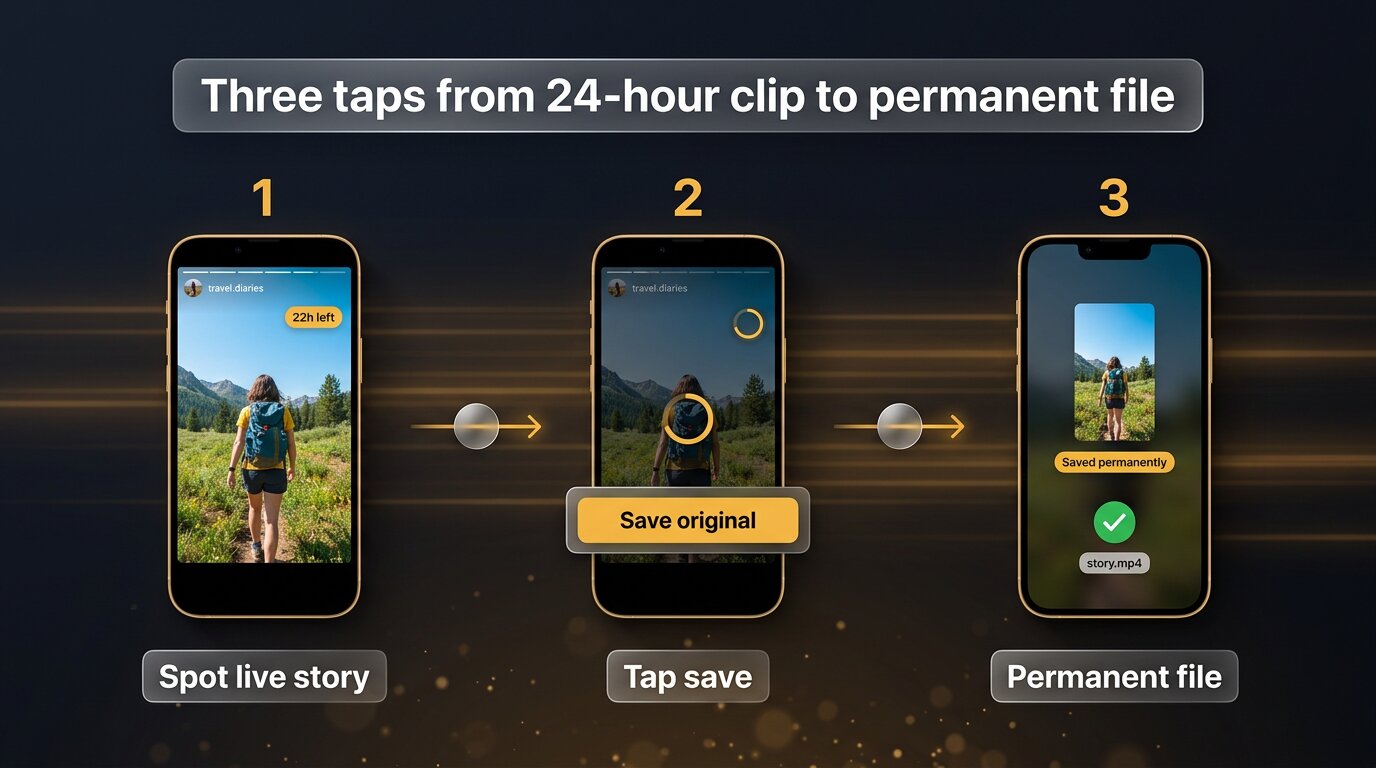
A story-download tool gives you exactly three steps to a permanent file:
- Open a viewer or downloader in any browser. No account, no app install.
- Type the public username (or paste a profile URL). Stories appear as preview tiles.
- Tap save. The original MP4 (for video) or JPG (for photo) downloads straight to your device.
That’s the entire flow. No watermark added, no compression pass, no UI overlay. The file format is universal — MP4 plays in every modern video app, JPG opens in every photo viewer. Once it’s on your device, it’s yours: the owner of the story cannot delete it from your gallery, the 24-hour timer no longer applies, and you can move the file anywhere you like.
Where saved stories actually live
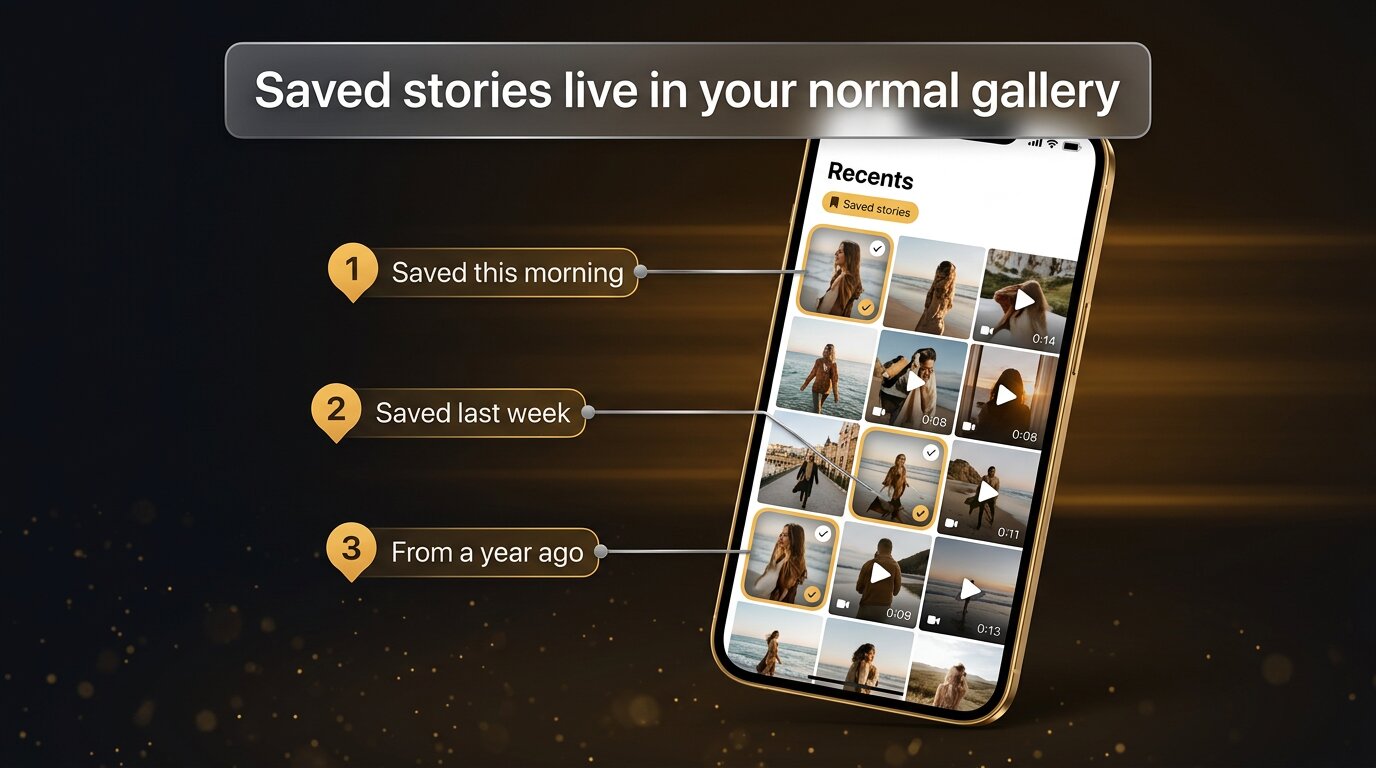
One question that surprises first-time users: where does the file go? The honest answer is — nowhere exotic. Saved story files land in:
- iPhone: the native Photos app, under “Recents”. Just like a photo you took yourself.
- Android: the Photos / Gallery app, usually under a “Downloads” album or the general camera roll.
- Desktop: the standard Downloads folder for your browser, named like “story_username.mp4”.
There’s no separate “saved stories” app on Instagram’s side, because Instagram has nothing to do with the file at this point. It’s a normal file on your device. You can move it, rename it, edit it, share it through any normal sharing menu, drop it into iMessage or WhatsApp or Slack, attach it to email — anything you can do with a regular photo or video.
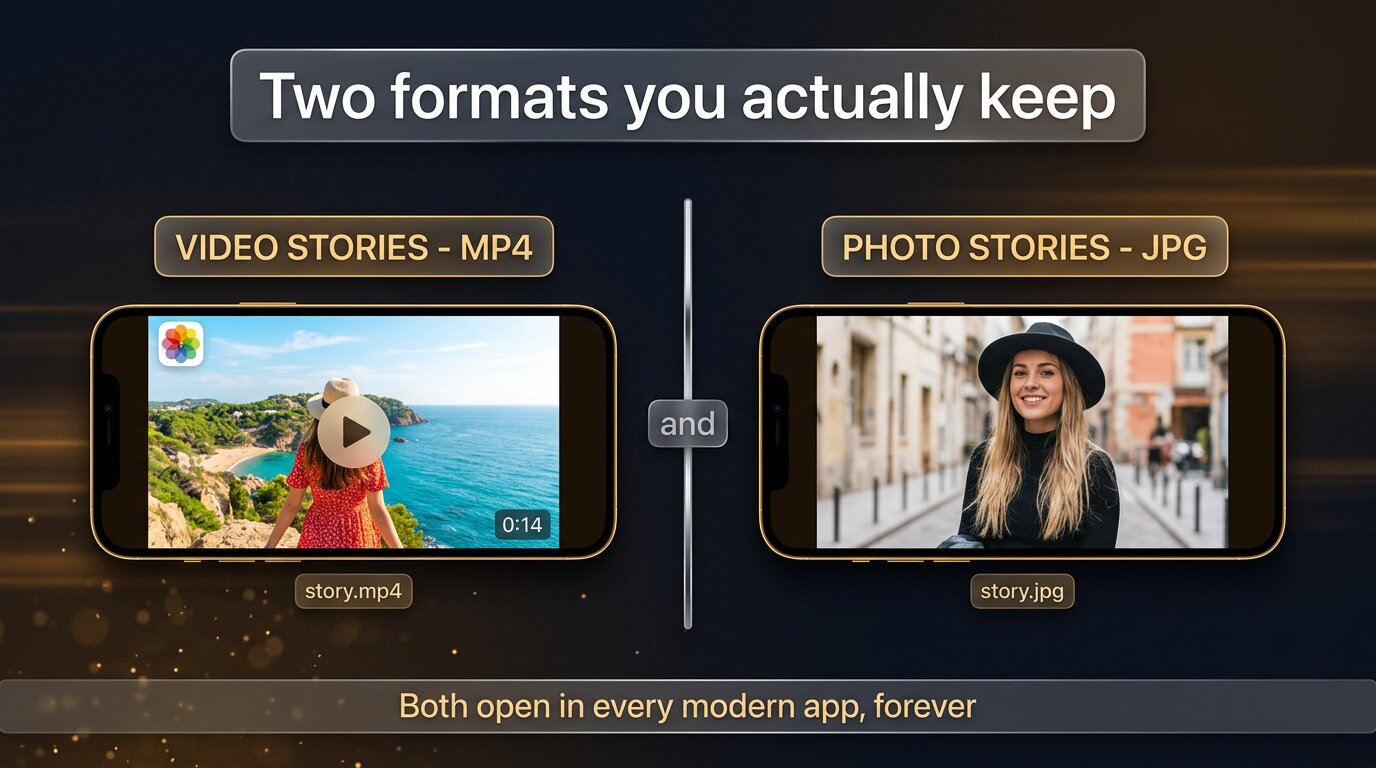
Two file formats cover every story type:
- MP4 for video stories. Plays in QuickTime, VLC, the native Photos app, every browser, every modern editor.
- JPG for photo stories. Opens in any image viewer, drops into design tools, prints cleanly.
If a downloader tries to give you a GIF instead of MP4, decline. GIF is an ancient format that crushes colour, kills motion smoothness, and inflates file size. The MP4 is the right choice every time.
Cloud backup as a safety net
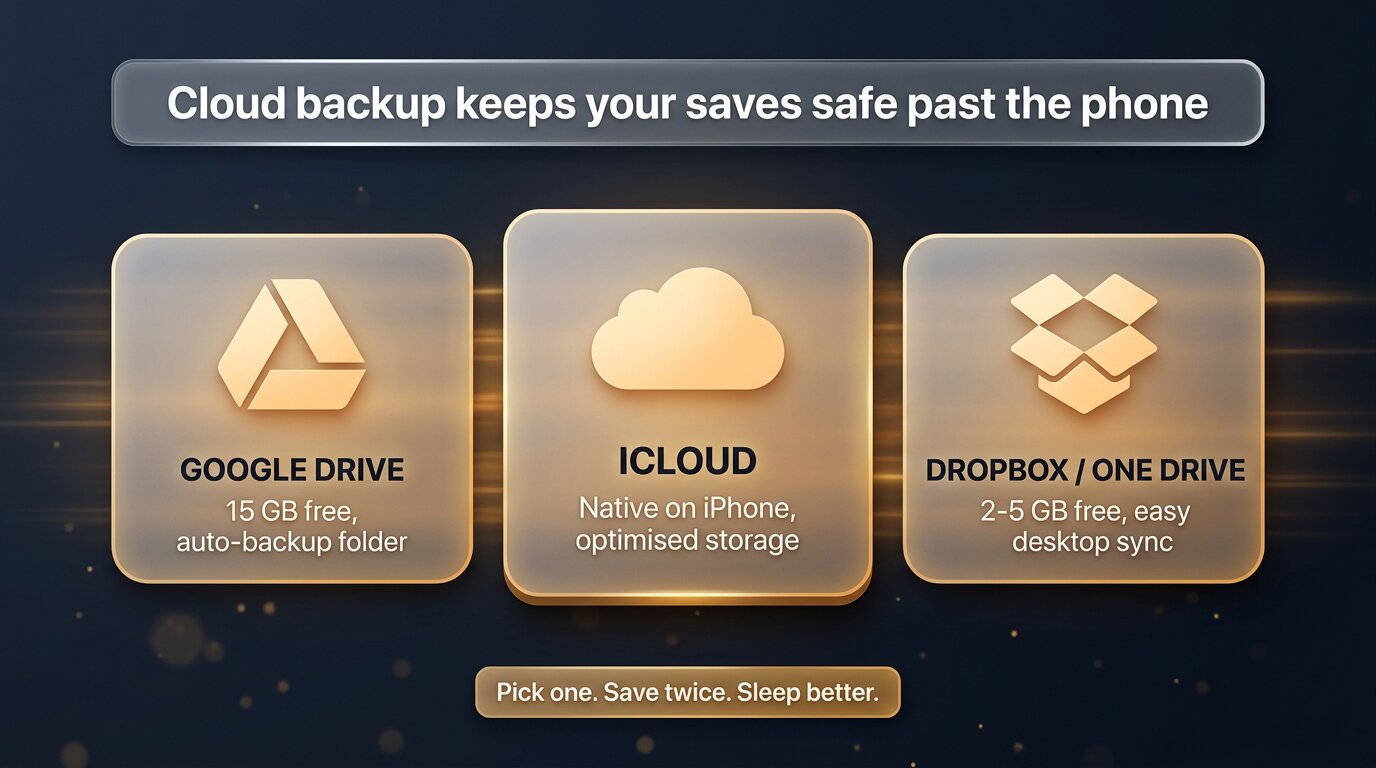
A file on your phone alone isn’t truly permanent — phones break, get lost, get factory-reset. The cheap insurance is one cloud backup. You don’t need anything fancy. Most people already have one of these turned on:
- iCloud — if you’re on iPhone, this is the path of least resistance. Photos and videos automatically back up; saved stories land there with no extra work.
- Google Photos — 15 GB free, automatic backup of your gallery on Android (and iPhone if you want it). Easiest cross-platform option.
- Dropbox / OneDrive — manual or auto-folder sync. Useful if you also keep a desktop archive and want both ends synced.
Turn on auto-backup once and your saved stories are now in two places — your phone and the cloud. Even if your phone is dropped into a pool tomorrow, the archive survives. For anything you genuinely care about, this is the difference between “saved” and “permanent”.
A few practical notes on cloud setup that save grief later:
- Pick one primary cloud, not five. Stories scattered across three services are worse than stories in one well-organised one. Decide which service you actually use and put the archive there.
- Watch the auto-backup conditions. Most services only back up on Wi-Fi by default, which is correct. Verify the setting before you assume a story is “safe”.
- Check the cloud once a quarter. Five minutes of looking at the actual folder confirms backups are running. Silent failures are the worst kind.
- Use a long-term plan for genuinely important media. A free 5 GB tier fills up the moment you start archiving seriously. A paid 100 GB plan costs the same as a sandwich a month.
Keeping a tidy story archive
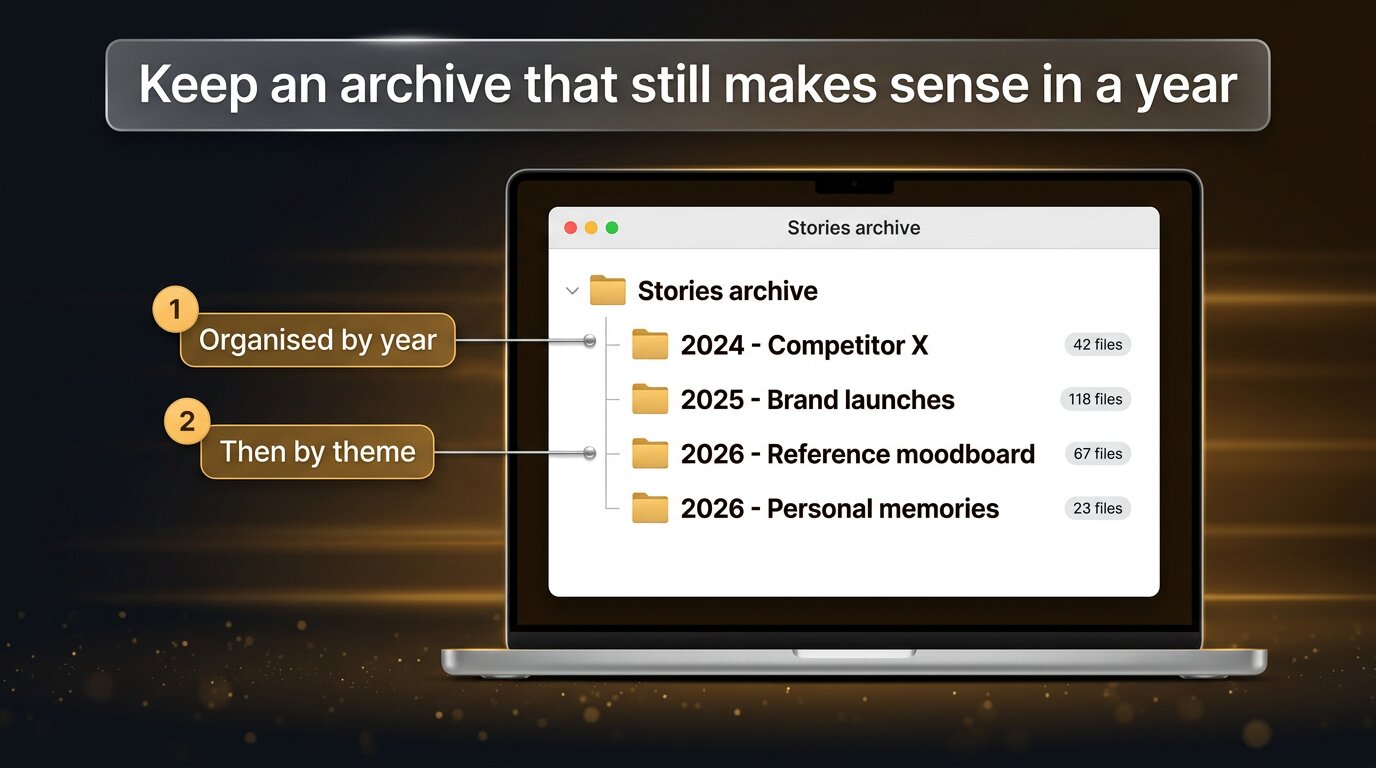
Saving stories is easy. Keeping them organised so you can find them later is the hard part. A pile of 400 randomly-named MP4 files in your Downloads folder is technically permanent and practically useless. Two simple rules turn a pile into an archive:
- File by year and theme, not by month. Coarse buckets are easier to maintain. “2026 / Brand launches” works; “May 2026 / Brand launches / Week 3” doesn’t.
- Rename meaningful files. “story_1742857.mp4” tells you nothing in six months. “competitor-launch-day1.mp4” tells you what you saved and why.
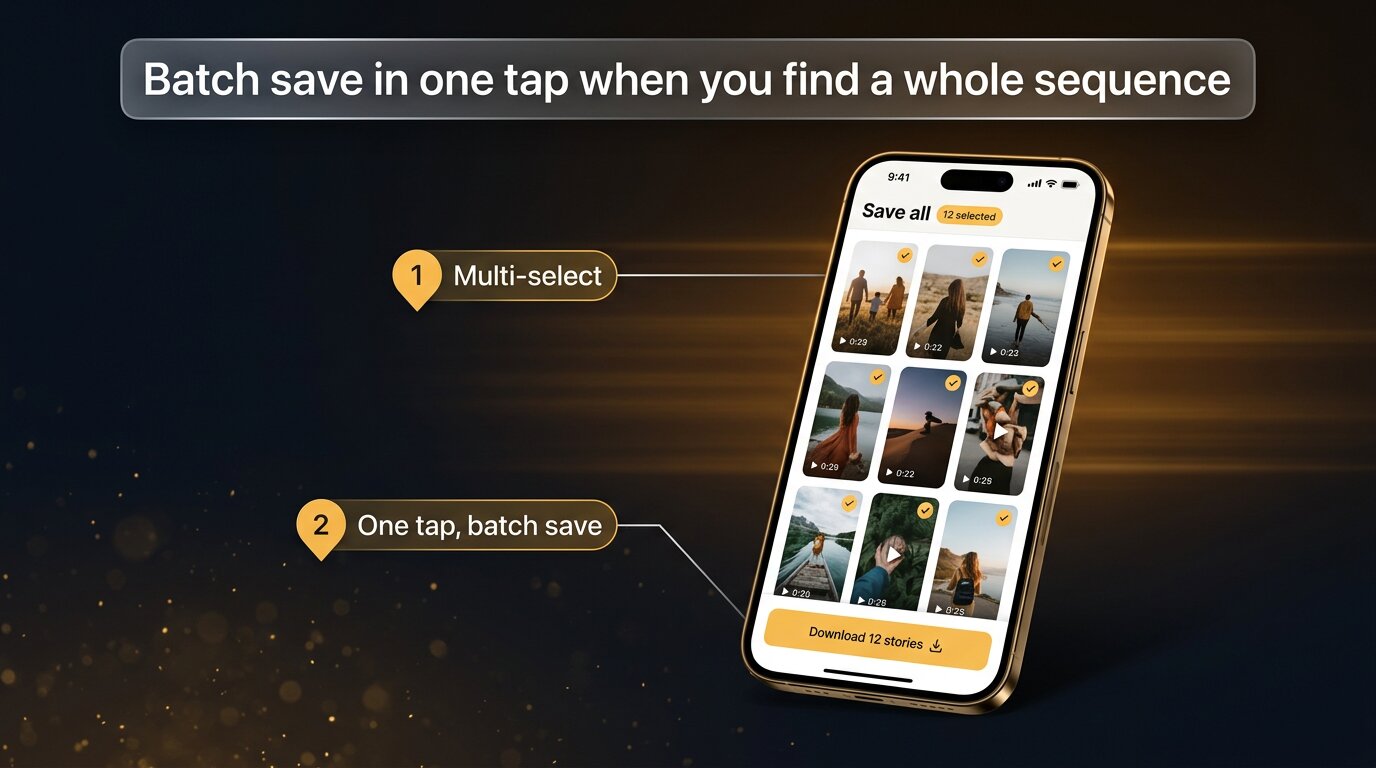
For accounts you watch closely, batch-save is the unlock — multi-select a whole sequence of stories and tap save once. It’s the right tool when a competitor drops a full launch sequence, when a friend posts twenty stories from a wedding, or when you’re archiving a year of your own creator output. The alternative (saving each story individually as it comes in) is real work; batch-save makes the daily archive a thirty-second habit.
A small set of habits keeps batch-saving from becoming a digital landfill:
- Save with intent, not by reflex. Just because you can grab every story doesn’t mean you should. Decide what you’re archiving for — memory, research, reference — before you start pressing buttons.
- Tag at the moment of saving. Adding a one-word tag (“wedding”, “launch”, “recipe”) takes two seconds now and saves an hour of guessing later.
- Move the batch out of Downloads weekly. The Downloads folder rotates, gets noisy, and is easy to accidentally wipe. Files you mean to keep belong somewhere you actually look.
When permanent saving genuinely helps
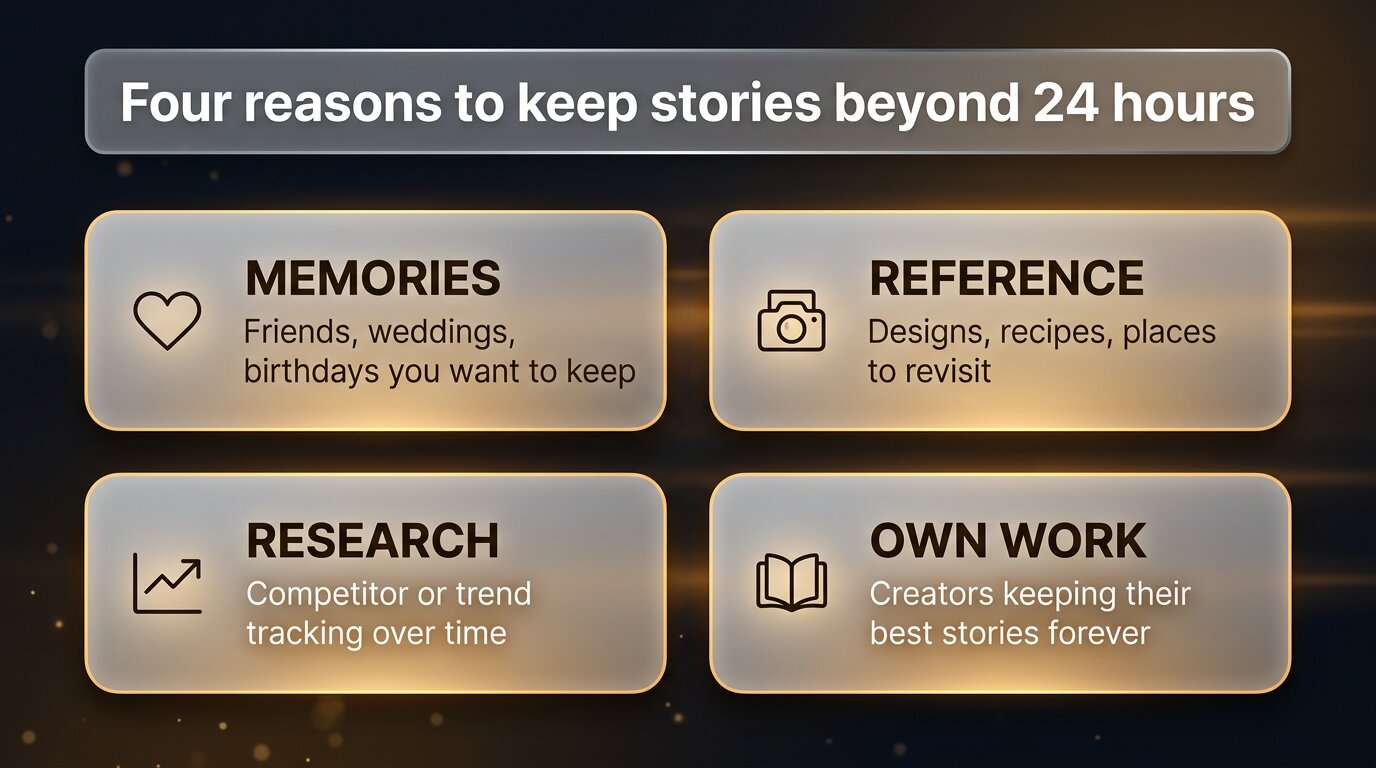
Not every story needs to be permanent — we cover that next. The genuine cases tend to fall in four buckets:
- Memories. The friend’s wedding, your kid’s school recital, the family holiday clip. These deserve more than a 24-hour life.
- References. Designs you want to revisit, recipes to actually try, places to visit, looks to copy — saving means you can come back.
- Research. Tracking competitor or trend output over weeks. The data is in the pattern, not any single story.
- Creator’s own work. If you posted it, you deserve to keep it. Build a year-end reel from your archive, not from Instagram’s deleted past.

The last case — saving your own work — is the one most often skipped. Instagram’s app has its own “archive” feature but it’s tied to your account; if the account is suspended, hacked or deleted, your archive goes with it. A locally-saved archive of your own stories survives platform problems entirely. Cheap insurance for anyone who treats their creative output seriously.
What you can’t save
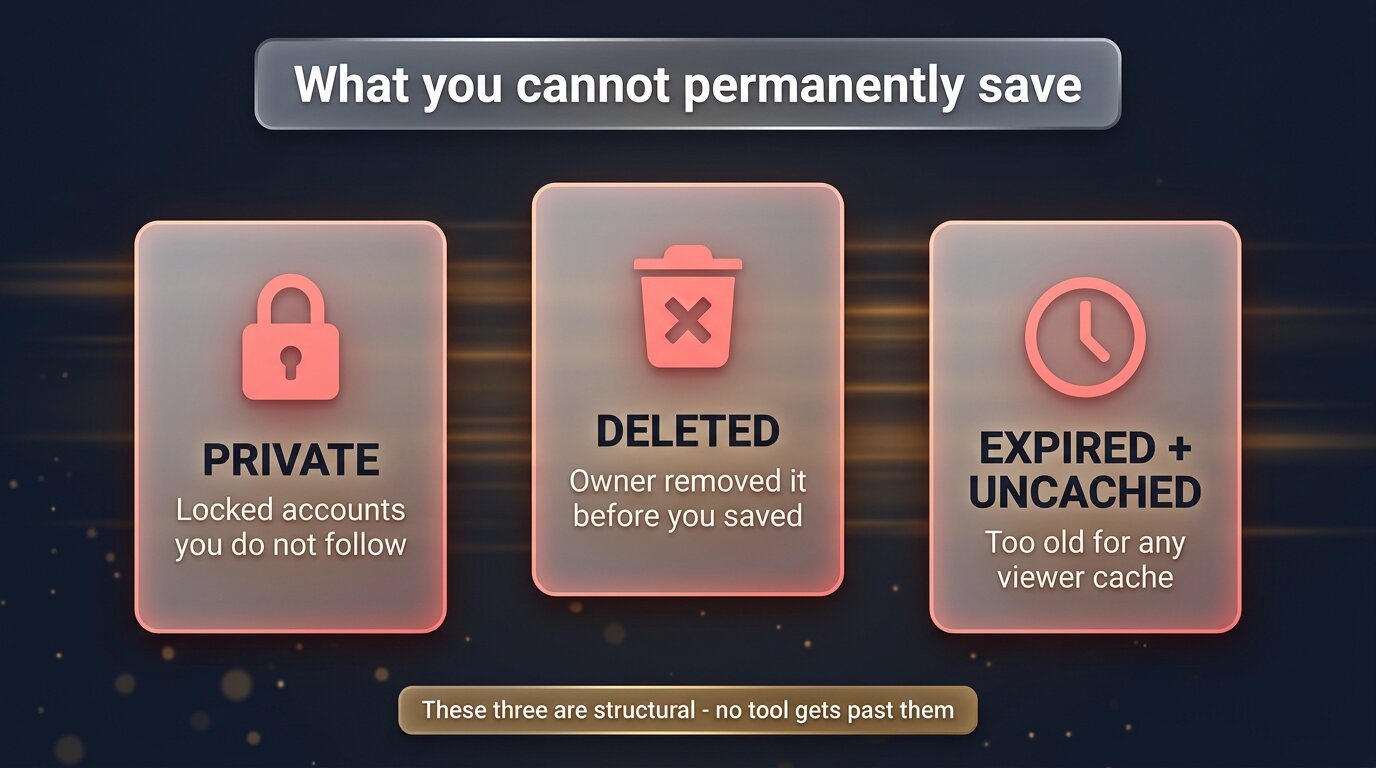
Three categories of stories cannot be saved permanently, no matter what tool you try. Knowing them saves time:
- Private accounts you don’t follow. Instagram’s server refuses to release their media to anyone outside the approved follower list. No third-party tool overrides this. The honest move is to ask for a follow.
- Already-expired stories with no cache. If the story is older than 24 hours and isn’t in any viewer cache, the public endpoint serves nothing. Best chance: ask the owner for a copy.
- Owner-deleted stories. Once the owner deletes a story before its 24 hours run out, it’s gone from Instagram’s servers immediately. Same answer.
Any tool that claims to permanently save private or deleted stories is either lying outright, stealing the Instagram password you give it, serving fake content, or running you through ad-fraud surveys. Real tools all draw the same line, because they all hit the same Instagram server.
A practical save-and-archive checklist
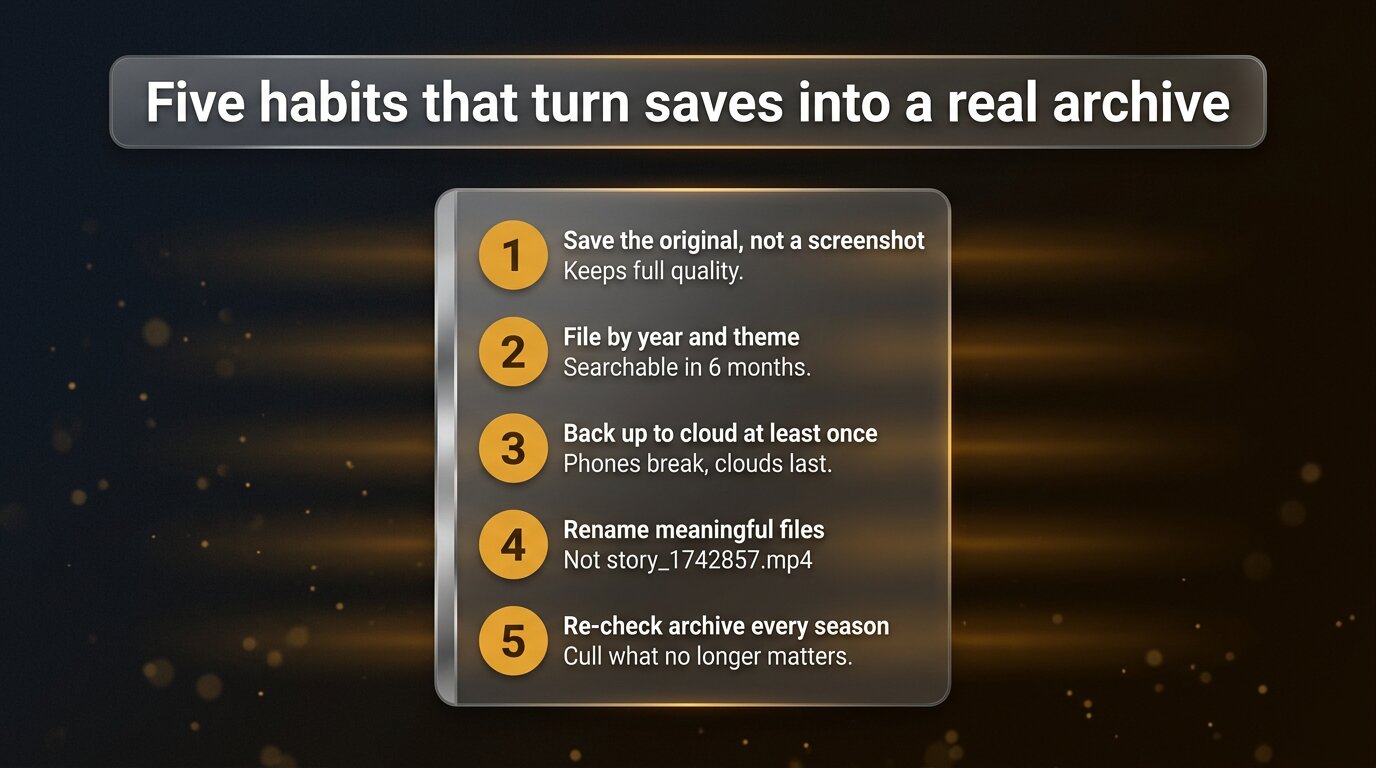
Five habits that turn casual saves into a real archive:
- Save the original file, not a screenshot. Use a downloader. Keeps full quality.
- File by year and theme. Searchable in six months, usable in two years.
- Back up to cloud at least once. Phones break, clouds last.
- Rename meaningful files. Not story_1742857.mp4. Add a person, an event, a topic.
- Re-check the archive every season. Cull what no longer matters. The shape stays sharp.
If you re-share a saved story: a quick word on etiquette
A saved story is yours as a file. That doesn’t automatically make it yours to publish. If the story is going somewhere public — a re-share on your own grid, a deck for a client, a thread on another network — the same etiquette that applies to quoting anyone else applies here:
- Credit the original creator. The handle, ideally a link. Whatever the platform makes possible.
- Re-share with context, not just content. “Loved this from @creator” is generous; silently lifting their work is the opposite.
- Ask first for anything commercial. A saved story is fine for your own viewing. Putting it on an ad, a paid deck, or a sold product is a different category of use that deserves an actual conversation.
- Respect “please don’t share”. If a creator says it, treat it the way you would in any other medium.
The shape of the rule is simple: the file is yours, the moment in it isn’t. Save freely. Use thoughtfully.
The bottom line
Saving Instagram stories permanently is about replacing “screenshot, hope it stays” with “original file, properly archived”. The flow is small — type a username, tap save, the original MP4 or JPG lands in your gallery. The discipline is also small — one cloud backup, folders by year and theme, meaningful filenames, a seasonal sweep.
Do that and the moments worth keeping — family, friends, your own work, the references that matter — outlive any 24-hour timer Instagram chose. Anything genuinely structural (private, deleted, long-expired) is off-limits, and that’s honest. For everything else, permanent really means permanent.
Explore more across GWAA: Download highlights permanently · Save profile pictures HD


